






 Settings
 Fast Delivery
 Free Shipping
 Incoterms
 Payment Types


 Marketplace Product

interview-with-Michael-Toutonghi-founder-of-functionalize
2015-11-17 | By Maker.io Staff
How did the idea for Functionalize come about?
Functionalize started as a school project that I worked on with my son. We were at the dinner table on my 50th birthday, discussing his school’s project fair, and decided to make something that we thought would be challenging, and that I had never made before—an electromagnetic rocket. We began researching what kinds of technologies we might use for such a device, like iron or other magnetic material launched with magnets. We ended up making this electromagnetic rocket as an air core inductor with a hollowed-out Estes rocket and an aluminum motor.
We made two earlier versions of the rocket and for the third one—which was the one that we had to demonstrate at the fair—I wanted to make sure it was put together well because it used high voltages and we didn’t want anything that might present a safety hazard. At the time, I was busy as a CTO for Parallels, and my son had already designed the launch pad for 3D printing, so I thought that we could just get a better 3-D printer for the job, one that could print the circuits as well as the structure. I naively assumed there must be a 3-D printer that would let us print all of the circuits, and by printing these parts, I wouldn't have to solder everything, but the rocket would be well put together.
After researching available 3D printers, even to the point of higher end systems not used by the typical maker, I found absolutely nothing that would allow me to print circuits. In fact, I found that many other people were looking for and asking about the same capability. I began to ask, “What is so hard about this?”
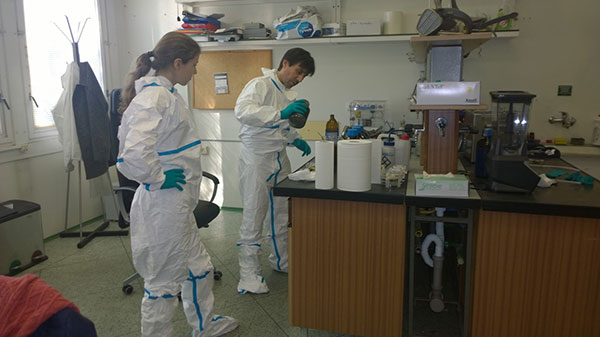
I started calling plastics companies to find a material that I might just extrude to filament, and I was told that there was no such material available at all. That really intrigued me, so I dove into the scientific literature and learned what people were doing in academia or published research to try to make processable conductive materials. After a while, I had some ideas that I believed could work and were not in any literature I found, so I built a small nano-materials lab and started making things. The early successes with these materials, that we have since far outdone, eventually led to the founding of Functionalize.
What were the challenges in making this product? What was the “eureka moment” when you made this work and realized you had a product?
I started by scouring the literature and learning about the challenges inherent in creating nanomaterials that could improve the properties of plastic. It is not hard to just take something to mix it up with plastic, but that's not going to get the performance that you need when you’re goal is unprecedented electrical conductivity. There were clearly many people working on the problem, and if it were easy, the material would have already been developed some time ago.
I looked at many options, including nanomaterials, such as graphene carbon nanotubes, metal nano-particles of various kinds, and even plastics that can conduct electricity without any filler at all. I eventually decided on an approach that used nanomaterials as conductive filler for the plastic. Clearly there were major challenges; In addition to using or developing an extremely conductive nanomaterial, I had to achieve maximum dispersion into the plastic of whatever I chose to use, make a stable product under thermoplastic processing conditions, form a strong interface between the material and the polymer matrix that would not lower conductivity, and create a way to do all of that at industrial scale. My earliest materials used a carbon metals framework, which was interesting because I had some really good success with that kind of solution but those early materials hadn’t run through an extruder yet. After developing some promising materials, I created the company, Functionalize, because my results were promising enough to convince me that there I had developed technology that would lead to a product, I just had to start developing actual filament.
Before doing that, I needed to know how my material stood up under extrusion conditions. I ended up buying a twin-screw extruder, and as soon as I started putting my early materials into a twin screw, sure enough, I ran into problems with material stability at those higher temperatures and pressures. I finally solved that problem, and at that point, I had a material that worked beautifully.
After successfully developing the material, what did Functionalize do next?
After development of a material, we had to move from lab scale, a few grams of material at a time, to industrial scale, producing kilograms. We started scaling up the batches and settled on a process that works in production—and that's where we are right now. In fact, we shipped the first orders to our customers on March 31.
Earlier this year, we also accepted outside investment, and now we are in the process of fulfilling our backlog of orders and running. We also recently announced a deal with Leapfrog, who will be making the material available as Maxx Electric. We have been working with them to ensure that their rollout goes smoothly, and we are expecting to announce other upcoming deals as well.
How did people react when you first presented your conductive filament material?
I’d say it was 99.99% positive—there were only a few that were skeptical. The skepticism was more of just asking questions about its properties. We got a really good response on our Kickstarter campaign, but at the same time, we set the bar really high. The money we raised was actually the money we really needed to set up the production to bootstrap. There was some skepticism until a few other companies started actually using F-Electric in their products. That clearly demonstrated that the material exists and works. At CES we were able to show an Arduino light sensor board that I printed with plastic traces that sensed light on the analog input. It was completely simple, but I was able to print a sensor board for a just few cents.
How conductive is the material?
The material is conductive at under 1 ohm-centimeter. (that was our commitment pre-production. we have since released a final production spec of 0.75 ohm-centimers). Our pre-production commitment was under 1 ohm*cm. The final product we shipped to people has 0.75 ohm*cm.
As far as making connections with these printed elements, is it all pressure fit?
The typical way to test plastics for electrical conductivity includes using a silver paint to eliminate or offset surface resistance, which is not the same as the volume resistivity. I started off with the intention of using silver-based material as an adhesive to make these connections. However, using these glues or paints requires time to dry and they don’t always make the connection you think they will when they are dry. Pressure definitely works, and we’ve found can even be more predictable. Still, pressure fitting still requires you to deal with surface resistivity, meaning every pressure-based connection is also a pressure sensor. Our best results have been a combination of fit and heat-assisted adhesion from a soldering iron.
From an engineering standpoint, how much more is needed in the development of this? How much have you scratched the surface, so to speak?
We have a product that enables applications now, so that part is done; there is no more R&D needed for F-Electric as a functional 3D printing material. At the same time, we are finding that in order to make the material suitable for even more applications, other properties such as a more elastic or softer material is sometimes desirable, depending on the product design. As a result, we believe there is room for additional products that might have a variety of mechanical and even electrical properties. As far as optimizing the material for electrical conductivity, there is room for improvement because we have much more conductive material in our labs. While higher levels of conductivity are currently too expensive to make as a general product, I believe further R&D and improving the things that make it work now as well as adding other aspects can result in future products that could take functional 3D printing beyond what we have achieved today.
F-Electric is our first product—it works well, it prints beautifully on most popular printers, and it prints parts that are stiffer and stronger than normal PLA. We are looking at the possibility of making materials even more conductive and also enhancing them with other properties, which might be desirable for functional prints. F-Electric is just the beginning, and our research and development of new 3D printing materials is always an exciting process that we believe will continue to enable important new 3D printing applications.






 Ireland